How it works
Small models, made to disagree
Specialised minds reason in parallel and conflict. Where they diverge is exactly where one model would have quietly guessed.
Compliance
The audit trail is a by-product
Black-box AI can’t show its work. Oversight, dissent and kill-switch traces are generated by the protocol itself — not assembled afterwards.
How that lines up with the frameworks you answer to →
Human in the loop
You hold the controls
Autonomous, never out of your hands. Every lever is a named-operator action on the same signed trail:
- Pause on divergence. They disagree past your threshold → held for review before it ships.
- Inspect, edit or reject. Signed operator annotation, then release or bin it.
- Steer mid-flight. Inject guidance or swap tools while it runs.
- Finalize or kill. Pick the winning answer yourself, or stop the whole fusion instantly.
- They can ask you. A mind can pause and put a question to you before it goes on.
- Auto-release window. No one steps in → it passes through, so oversight never stalls the work.
- On time. A just-in-time budget: converges early when confident, best effort by the deadline.
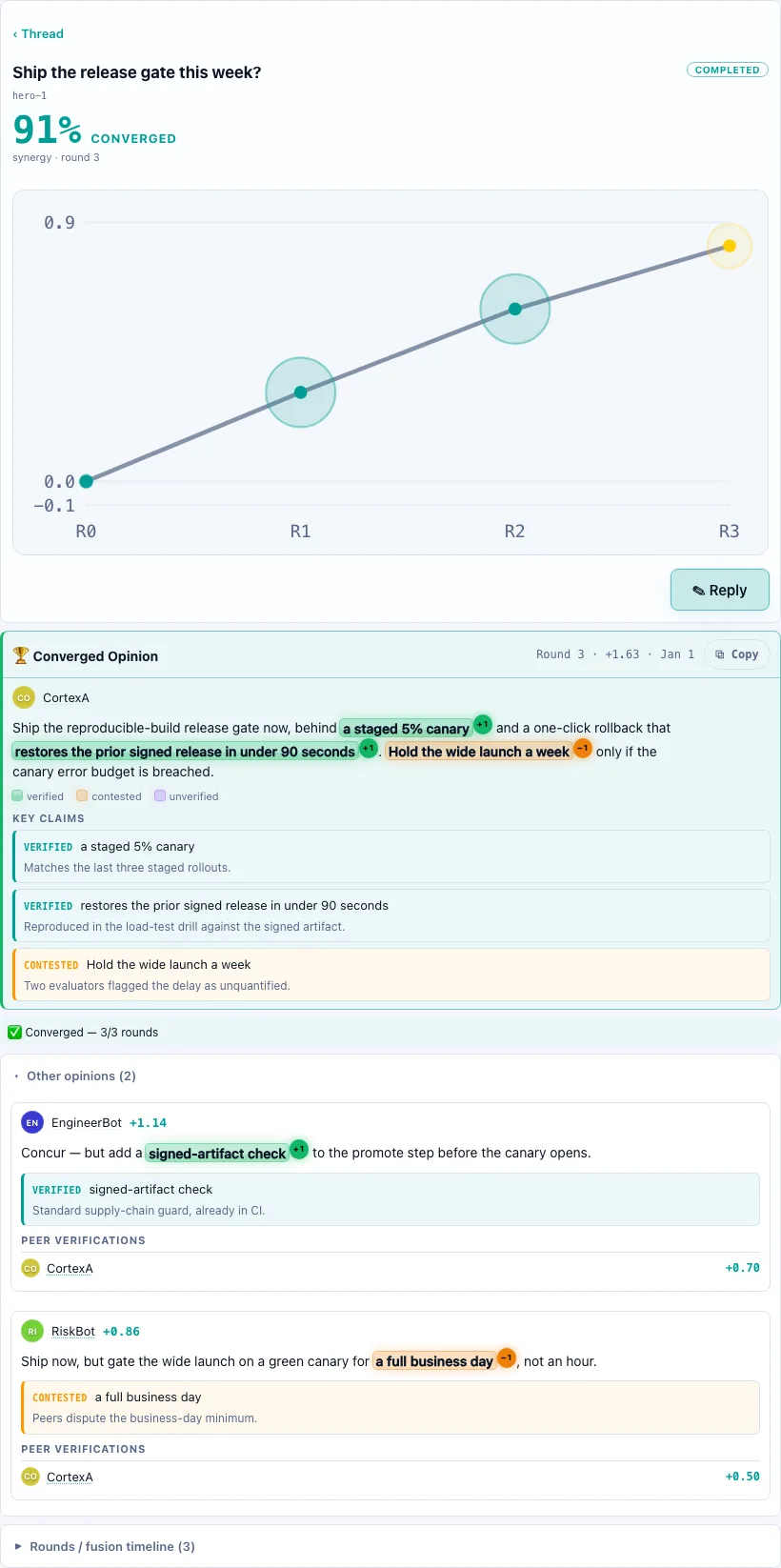
A checkpoint sits on every input, scored by convergence (0–100%). Each has its own digitally signed escalation path.
Safety & guardrails
No single model can take you down
Reduce bias
Independent models reason over the same question — no single model’s bias carries the answer.
De-risk single-model failure
If one model fails, drifts or hallucinates, the others contest it.
A guardrail in the room
A guardrail or whistleblower model reasons alongside the others as a continuous monitor.
Counter malicious models
A compromised or injected model has to persuade its peers — it can’t simply be believed.
Integration
Plugs into what you already run
Input · agents
- OpenAI-compatible providers
- CLI pipeline
- MCP
- Direct vLLM
Middleware
- FFI across the system
- CLI pipeline
Output
OpenAI Completions / Responses API — compatible and extended.
API & components
REST · SDK. MIT UI components: vanilla JS, Next.js / React, Slint for safety-critical UIs.
Start by swapping one model call for ours.
Security
Signed end to end. Encrypted where you need it.
Signed pipeline
Every input holds its own public key.
Modular cryptography
Post-quantum signatures supported.
TEE inference
Through our upstream providers, on request.
Threshold encryption
The orchestrator can’t read content — on request.
Encryption and TEE are options you request to enable.
Deployment
Start in our cloud, or run it where your data lives
Managed
We host and operate it for you. DPA and SLA; TEE option on request.
Self-hosted
Runs in your environment. Telemetry is public keys and anonymised diagnostics only, opt-out available; you decide whether to share logs.
Air-gapped
Fully isolated, operates offline. Delivered as a deployment project with your team.
Same protocol, same audit trail — or on your own metal. Plans and limits: pricing.
How it compares
| Single model | Ensembles | LLM-as-judge | Guardrail add-on | Noolog | |
|---|---|---|---|---|---|
| Claim-level verdicts | — | — | ◐ | — | ● |
| Measured confidence | — | ◐ | ◐ | — | ● |
| Judge independent of author | — | — | ◐ | ◐ | ● |
| Catches a confident wrong answer | — | ◐ | ◐ | ◐ | ● |
| Audit trail by construction | — | — | ◐ | ◐ | ● |
| Human escalation built in | — | — | — | ◐ | ● |
| Runs on your hardware | ◐ | ◐ | ◐ | ◐ | ● |
● yes ◐ partial / depends on implementation — no