The premise
Many minds beat one — measurably.
One model is one opinion. Noolog joins many models together — each strong at something different — and has them critique each other and converge, like asking a team instead of one person. Anyone can add their own expert too: it learns from how you already work, no tech skills needed.
Because those minds come from different labs, the thing you end up talking to is bigger than any of them alone: the combined frontier capability of several, in one seat. No lab sells you its rivals' models — the fusion is the only place they meet.
Peer-reviewed — NSED, arXiv 2601.16863.
The proof
Every answer is cited — verifiable, not asserted.
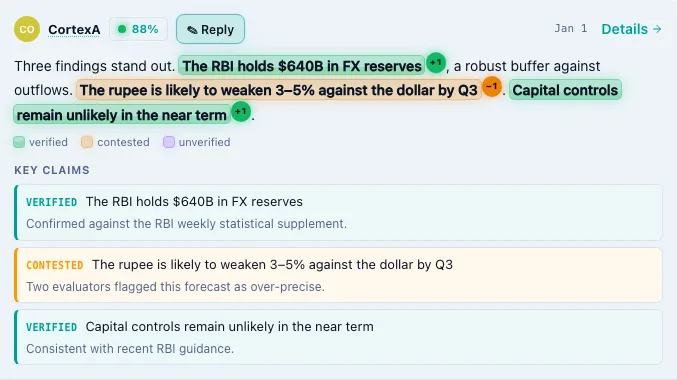
You get a confidence score, and each claim is highlighted verified (green) or contested (amber) right in the answer, with the evaluators' reasons in a Key Claims list. The whole thing is a tamper-evident, cryptographically chained record — nothing is a black box.
The scope
Where privacy actually holds — and where it doesn't.
Two paths give you real sovereignty. Bring your own models (BYOK) and we never see your keys — inference stays on your side even when orchestration runs through us. Or run Noolog on infrastructure you own today, and nothing crosses your boundary at all. Every claim we make about keys, egress and residency is scoped to those two.
On the hosted gateway it is different, and we would rather say it than let you assume: your prompt goes out to third-party model providers, and some tiers sit outside the EU. Full end-to-end privacy, where nothing leaves your device at all, arrives with encrypted orchestration (coming soon). For an enterprise the box is also the cheap door in: frontier-grade reasoning on-prem, inside your own network, without the six- or seven-figure contract usually attached to it.
Go deeper: the hardware root of trust → · identity-aware networking → · the full vision →